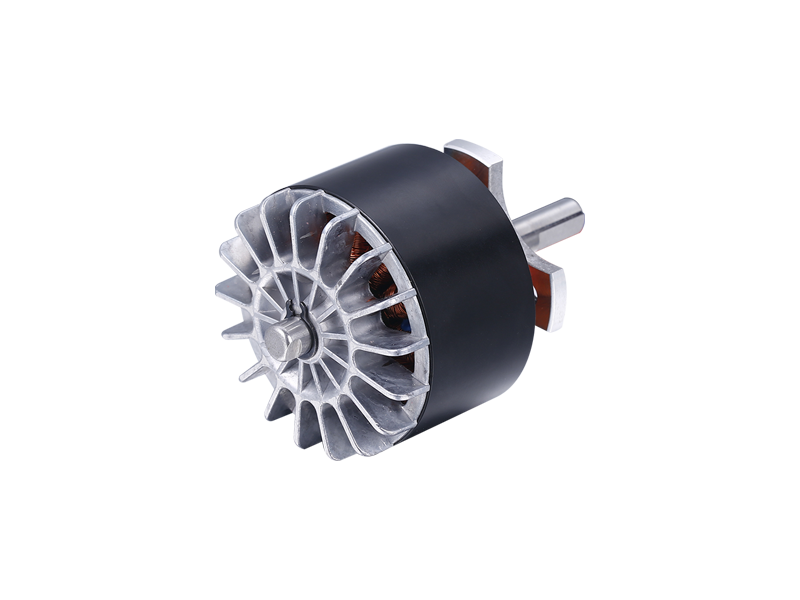
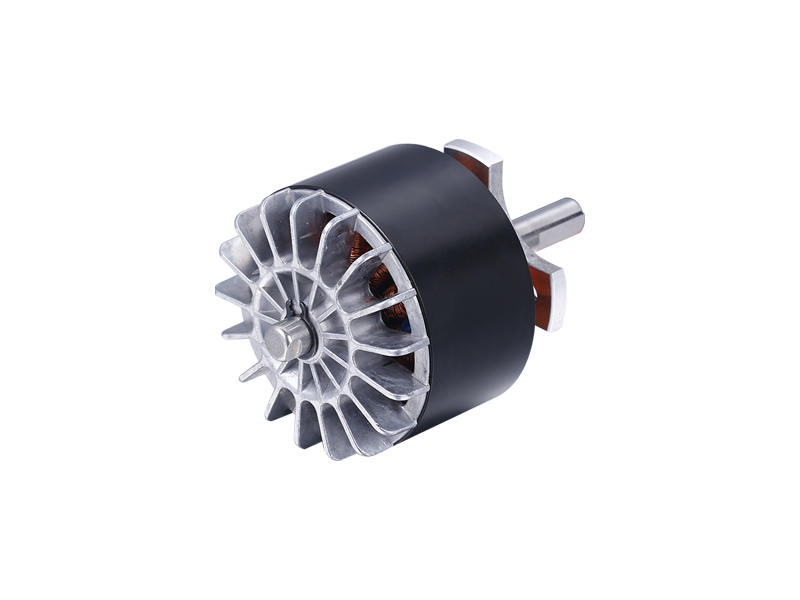
What factors determine the speed of a brushless motor?
In the fields of industrial automation, drones, power tools, etc., brushless motors are gradually replacing traditional brushed motors with their advantages of high efficiency, quietness, and long lifespan. However, many users may encounter problems such as substandard speed and large fluctuations during use. This article will start from technical principles and combine industry cases to analyze the core factors that affect the speed of brushless motors, helping users to scientifically select and debug.

1、 The underlying logic of brushless motor speed
Brushless motors belong to synchronous motors, and their speed follows the synchronous speed formula:
RPM=60 x frequency (Hz) ÷ pole pairs
This formula reveals the direct relationship between rotational speed, power supply frequency, and number of motor poles. For example, a 4-pole logarithmic motor with a theoretical speed of 750RPM under 50Hz power supply; If the power supply frequency is increased to 100Hz, the speed can reach 1500RPM. However, in practical applications, the rotational speed is also affected by the following factors.
2、 The five key factors that determine the rotational speed
1. Supply voltage and current
Voltage: As an energy source, the higher the voltage, the greater the electromagnetic torque of the motor and the faster the speed. However, excessive voltage can lead to magnetic saturation and uncontrolled temperature rise. For example, the motor of a certain drone can rotate at 10000RPM under 24V voltage, and can reach 15000RPM after being increased to 36V, but it needs to be equipped with a cooling system.
Current: The magnitude of the current directly affects the torque output. Under high load, the current increases and the speed may decrease due to power limitations. For example, the speed of an electric tool remains stable when unloaded, but decreases by 20% -30% after loading.
2. Motor design parameters
Polar number: The more polar numbers there are, the lower the speed, but the greater the torque. For example, drones commonly use 2-pole logarithmic motors to pursue high speeds, while electric vehicle drive motors often use 8-12 pole logarithmic motors to balance torque and efficiency.
Winding turns: Increasing the number of turns will increase the magnetic flux, but at the same time increase the inductance, limit the current response speed, and indirectly affect the speed. A high-speed centrifuge increased its speed from 30000 RPM to 50000 RPM by reducing the number of turns and increasing the wire diameter.
Magnetic pole structure: Surface mounted magnetic poles are suitable for high-speed applications, while embedded magnetic poles focus more on torque density. For example, the joint motor of industrial robots often adopts an embedded design to cope with frequent start stop.
3. Control system strategy
FOC control: Field Oriented Control (FOC) achieves wide range speed regulation by real-time adjustment of current phase and amplitude. After adopting FOC, the speed fluctuation of a certain CNC machine tool decreased from ± 5% to ± 0.5%.
PWM speed regulation: By adjusting the duty cycle, the average voltage is changed, but torque ripple is significant at low speeds. For example, electric scooters may experience jolts when climbing at low speeds.
Closed loop control: Encoder feedback can achieve precise speed control, but the cost increases. High end drone gimbal motors commonly adopt closed-loop design, with a speed accuracy of ± 1RPM.
4. Load and mechanical losses
Load characteristics: Inertial loads (such as flywheels) delay speed changes, while frictional loads directly consume power. The speed of a logistics sorting AGV motor decreases by 15% when fully loaded, and algorithm compensation is required.
Transmission efficiency: The efficiency loss of transmission components such as gearboxes and belts can reach 5% -20%. For example, a certain industrial fan motor has a nominal speed of 6000RPM, but after passing through a gearbox, the actual output speed is 3000RPM.
5. Environmental and aging factors
Temperature: High temperature can cause demagnetization and increased resistance of magnetic steel. The speed of a certain outdoor monitoring gimbal motor decreased by 8% in a 40 ℃ environment, and the heat dissipation design needs to be strengthened.
Aging: Bearing wear, demagnetization of magnetic steel, and other factors can reduce efficiency. After 3 years of use, the motor speed of a certain medical device has decreased by 12% and requires regular maintenance.
3、 How to optimize the speed of brushless motor?
Selection stage: Select pole pairs based on load characteristics, such as 2-4 pole pairs for high-speed requirements and 8-12 pole pairs for high torque requirements.
Control strategy: For scenarios with high speed accuracy requirements (such as 3C equipment), closed-loop control+FOC algorithm is adopted.
Heat dissipation design: High speed motors need to be equipped with liquid cooling or air cooling systems, for example, a high-speed spindle motor controls the temperature rise within 30 ℃ through oil cooling.
Maintenance: Regularly check the bearing clearance and magnetic flux of the magnet, and replace aging parts in a timely manner.