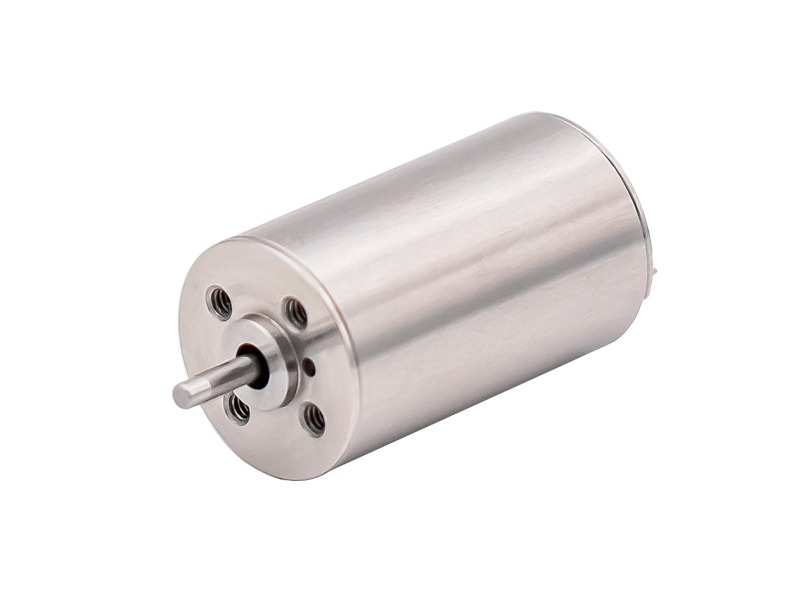
Three commonly used position sensors for brushless DC motors.
Today, TOPBAND MOTOR will introduce three commonly used position sensors for brushless DC motors. Before we formally introduce it, let's first understand what a position sensor is.
The commutation of the motor is determined by the position of the rotor. The position sensor can detect the relative position between the rotor and the stator winding during motion, convert the position signal in the magnetic field into an electrical signal, and provide correct commutation information for the logic switch circuit. It controls its conduction and turn off, so that the winding current in the motor changes phase in sequence with the change of rotor position, forming a stepwise rotating magnetic field in the air gap, and driving the motor rotor to rotate continuously.
Permanent magnet synchronous motors (sine wave drive) generally use rotary converters, absolute photoelectric pulse encoders, and incremental photoelectric pulse encoders to continuously detect rotor position, with high resolution and high cost.
The working principle of a
brushless DC motor is similar to that of a brushed motor, which uses mechanical brushes and commutators to reverse the current in the winding. Brushless DC motor (square wave drive) only requires discrete rotor position information. For the three-phase six state working mode, under one pair of poles, only six commutation point moments need to be determined, and the accuracy requirement is not high. Therefore, a simple low-cost position sensor can be used (except for using sensorless control, sensorless control does not require a position sensor).
The commonly used position sensors for brushless DC motors are magnetic sensitive, photoelectric, and electromagnetic. as follows:
(1) Magnetic position sensors include Hall elements, magnetic diodes, magnetic conductive tubes, magnetic resistors, or specialized integrated circuits. Installed on the stator, detect the magnetic field changes caused by the rotation of the rotor.
(2) A photoelectric position sensor is equipped with a photoelectric sensing device at a certain position on the stator component, a light shielding plate on the rotor, and a light source of LED or small bulb. When the rotor rotates, the photosensitive elements on the stator will generate pulse signals at certain frequency intervals due to the effect of the light shielding plate.
(3) Electromagnetic position sensors are installed on the stator with electromagnetic sensor components. When the position of the permanent magnet rotor changes, the electromagnetic effect will cause the electromagnetic sensor to generate high-frequency modulation signals (whose amplitude changes with the rotor position).