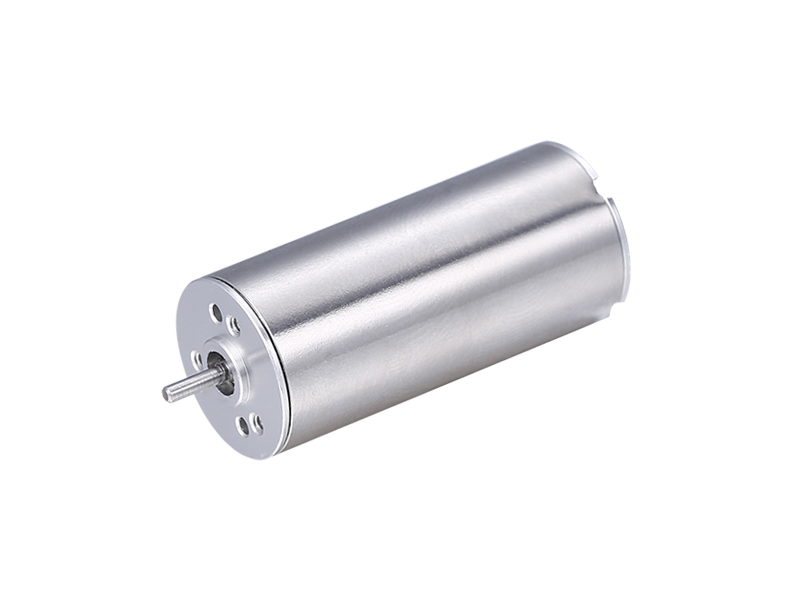
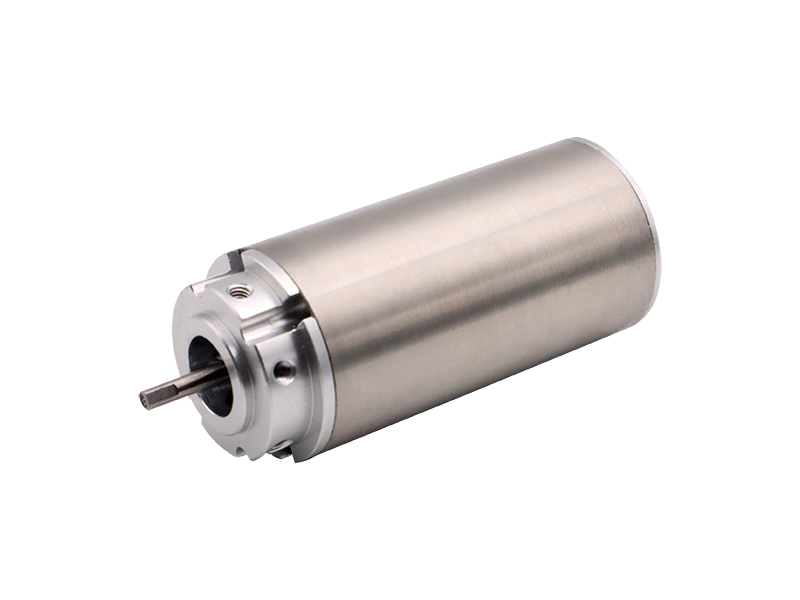
Structural principle and characteristics of brushless DC motor.
1、 Working principle of brushless DC motor
A brushless DC motor consists of a main body and a driver, and is a typical electromechanical integrated product. The stator winding of DC brushless motors is often made into a three-phase symmetrical star connection, which is very similar to three-phase asynchronous DC brushless motors. The rotor of a DC brushless motor is attached with magnetized permanent magnets. In order to detect the polarity of the rotor of the DC brushless motor, a position sensor is installed inside the motor. The driver is composed of power electronic devices and integrated circuits, and its function is to receive start, stop, and brake signals from the DC brushless motor to control the start, stop, and braking of the DC brushless motor; Receive position sensor signals and forward/reverse signals to control the on/off of each power transistor in the inverter bridge, generating continuous torque; Accept speed commands and speed feedback signals to control and adjust the speed; Provide protection and display, etc.

DC motors have fast response, large starting torque, and the ability to provide rated torque from zero speed to rated speed. However, the advantages of DC motors are also their disadvantages, because in order to generate constant torque under rated load, the armature magnetic field and rotor magnetic field must be maintained at a constant 90 ° angle, which requires the use of carbon brushes and rectifiers. Carbon brushes and rectifiers generate sparks and carbon powder when the motor rotates, which not only causes component damage, but also limits their usage. AC motors do not have carbon brushes or rectifiers, are maintenance free, sturdy, and widely used. However, to achieve performance equivalent to DC motors in terms of characteristics, complex control technology is required. The rapid development of semiconductors nowadays has greatly accelerated the switching frequency of power components, improving the performance of drive motors. The speed of microprocessors is also increasing, which can realize the control of AC motors in a rotating two axis Cartesian coordinate system, and appropriately control the current components of AC motors in both axes, achieving similar performance to DC motor control and comparable to DC motors.
2、 Structure of DC brushless motor
DC brushless motor is a type of synchronous motor, which means that the speed of the motor rotor is affected by the speed of the rotating magnetic field of the motor stator and the number of rotor poles (p): n=60.f/p. When the number of rotor poles is fixed in a DC brushless motor, changing the frequency of the stator rotating magnetic field can change the rotor speed. DC brushless motor is a synchronous motor with electronic control (driver), which controls the frequency of the stator rotating magnetic field and feeds back the speed of the motor rotor to the control center for repeated correction, in order to achieve a way that is close to the characteristics of a DC motor. That is to say, brushless DC motors can still control the rotor of the motor to maintain a certain speed within the rated load range when the load changes.
The DC brushless driver includes a power supply unit and a control unit: the power supply unit provides three-phase power to the motor, and the control unit converts the input power frequency according to demand. The power supply unit can directly input DC power (usually 24V) or AC power (110V/220V). If the input is AC power, it must first be converted to DC through a converter. Whether it is direct current input or alternating current input, before entering the motor coil, the direct current voltage must be converted from the inverter to a three-phase voltage to drive the motor. Inverter is generally composed of six power transistors (q1~q6) divided into upper arm (q1, q3, q5)/lower arm (q2, q4, q6) connected to the motor as a switch to control the flow through the motor coil. The control department provides PWM (Pulse Width Modulation) to determine the frequency of power transistor switching and the timing of inverter commutation. DC brushless motors are generally intended for speed control where the speed can remain stable at the set value without significant changes when the load changes. Therefore, DC brushless motors are equipped with Hall sensors that can induce magnetic fields inside, which serve as closed-loop control for speed and also as the basis for phase sequence control. But this is only used as speed control and cannot be used as positioning control.
Structural principle and characteristics of brushless DC motor
3、 Characteristics of DC brushless motor
1. Brushless DC motor can replace DC motor speed regulation, frequency converter+variable frequency motor speed regulation, asynchronous motor+reducer speed regulation;
2. Brushless DC motors have the advantages of traditional DC motors, while eliminating the carbon brush and slip ring structures;
3. Brushless DC motors can operate at low speeds and high power, eliminating the need for a gearbox to directly drive large loads;
4. Brushless DC motors have small size, light weight, and high output;
5. DC brushless motors have excellent torque characteristics, good torque performance at medium and low speeds, large starting torque, and small starting current;
6. DC brushless motor with stepless speed regulation, wide speed range, and strong overload capacity;
7. Brushless DC motors have good soft start and stop characteristics, and can eliminate the need for mechanical or electromagnetic braking devices;
8. DC brushless motors have high efficiency, and the motor itself has no excitation loss or carbon brush loss, eliminating multi-stage deceleration loss and achieving a comprehensive energy-saving rate of 20% to 60%.
9. Brushless DC motors have high reliability, good stability, strong adaptability, and simple maintenance and repair;
10. DC brushless motor is resistant to bumps and vibrations, with low noise, minimal vibration, smooth operation, and long service life;
11. DC brushless motors do not generate sparks and are particularly suitable for explosive environments, with explosion-proof types available;
12. DC brushless motors can be selected from trapezoidal wave magnetic field motors and sine wave magnetic field motors as needed.