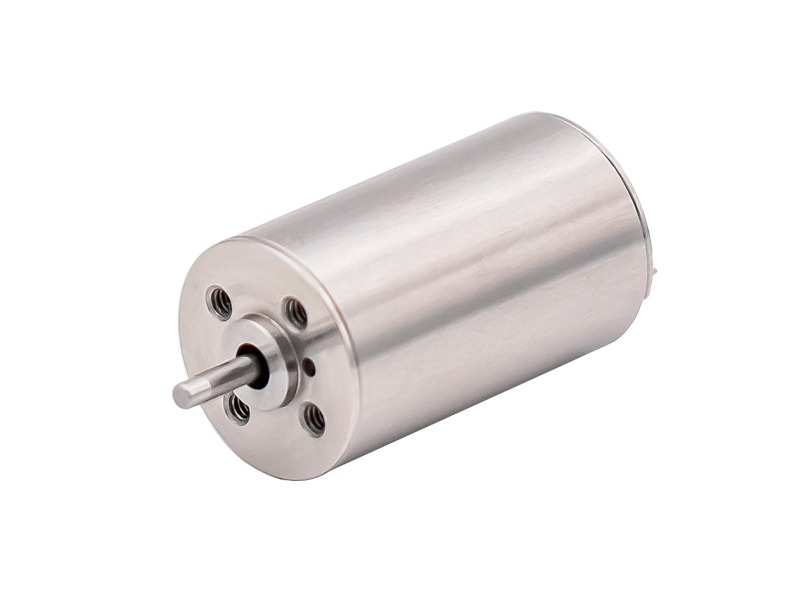
Requirements for motors in robot hands.
A robot needs to complete research and production, and many parts require motors for control, such as the upper limbs, legs, shoulders, elbows, etc. Among these parts, the flexibility requirements for finger joints are very high.
Recently, we have also frequently encountered customers inquiring about robot finger joint motors. Today, we will introduce them to you.
1. Rapid speed
The time from obtaining the command signal to completing the required working state of the motor should be short. The shorter the response time to the command signal, the higher the sensitivity and fast response performance of the electric servo system. Generally, the electromechanical time constant of the servo motor is used to illustrate the fast response performance of the servo motor.
2. The starting torque inertia ratio is large
When driving the load, it is required that the servo motor of the robot has a high starting torque and a low moment of inertia.
3. Continuity and linearity of control characteristics
As the control signal changes, the speed of the motor can continuously vary, and sometimes the speed needs to be proportional or approximately proportional to the control signal.
4. Wide speed range
Can be used in a speed range of 1:1000 to 10000.
5. Small size, small mass, and short axial dimension
6. Can withstand harsh operating conditions
Can perform very frequent forward and reverse and acceleration/deceleration operations, and can withstand overload in a short period of time.