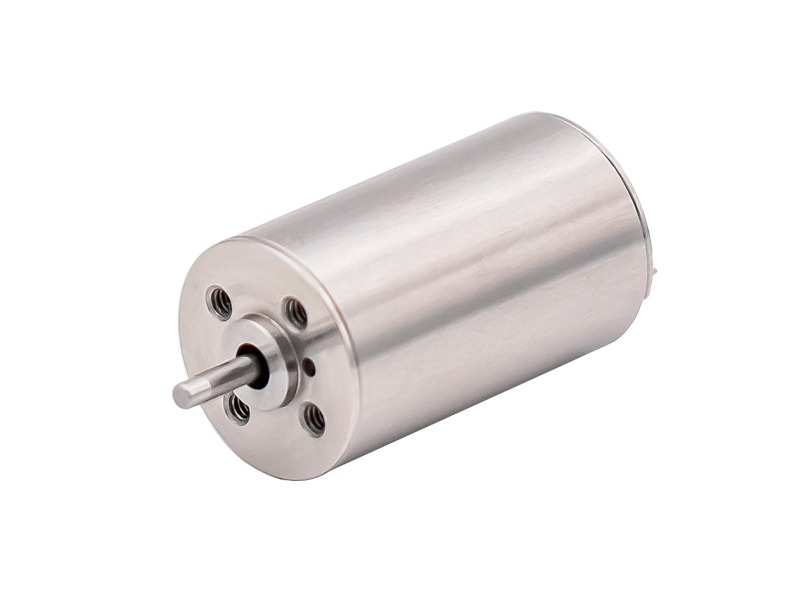
From the perspective of definition and differences, brushless DC motors and stepper motors.
We all know that motors can be classified in various ways, and today we will focus on introducing two types among them—brushless DC motors and stepper motors.
From the definition
The
brushless DC motor is a high-performance electric motor with the most notable feature being its external characteristics of a DC motor without the mechanical contact structure of brushes. It employs a permanent magnet rotor, eliminating excitation losses, and the heating armature winding is mounted on the external stator, facilitating heat dissipation.
A stepper motor is an open-loop control component that converts electrical pulse signals into angular or linear displacement. Under non-overload conditions, the motor's speed and stopping position depend solely on the frequency and number of pulse signals, unaffected by load variations.
From the perspective of differences
DC brushless motors have higher rotational speeds than stepper motors.
2. The driving principles of brushless DC motors and stepper motors differ. Brushless DC motors rely on Hall elements for positioning to control rotation via alternating power supplies. Stepper motors are directly driven by single-phase pulse voltage, eliminating the need for Hall element positioning. By controlling the number of pulses supplied to the motor, precise rotational angles can be achieved.
3. Due to their different driving principles, DC brushless motors are generally used in applications with lower control precision requirements, while stepper motors are employed in scenarios demanding higher control precision.