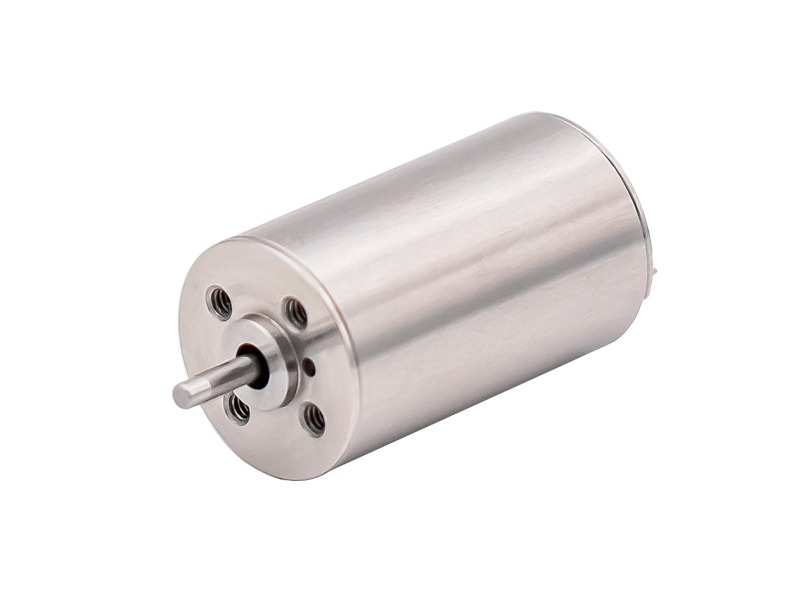
Do you know what parts a brushless DC motor consists of?
There are various types of motors, and brushless DC motors are currently the most ideal speed-regulating motors. Brushless DC motors combine the advantages of both DC and AC motors, featuring the excellent adjustment performance of DC motors along with the simple structure, absence of commutation sparks, reliable operation, and ease of maintenance of AC motors. As a result, they are highly popular in the market and widely used in automotive, household appliances, industrial equipment, and other fields. Today, let's take a look at the structure of brushless DC motors.
A brushless DC motor primarily consists of a rotor made from permanent magnetic materials, a stator with coil windings, and a position sensor (optional).
Stator
The stator structure of a brushless DC motor is similar to that of an induction motor. It consists of stacked steel laminations with axial slots for winding. The windings in a brushless DC motor differ slightly from those in a traditional induction motor.
Typically, most brushless DC motors consist of three stator windings connected in a star or "Y" configuration (without a neutral point). Additionally, based on coil interconnection, the stator windings are further categorized into trapezoidal and sinusoidal motors.
2. Rotor
The rotor part of a brushless DC motor consists of permanent magnets (typically rare-earth alloy magnets, such as neodymium (Nd), samarium cobalt (SmCo), and neodymium iron boron (NdFeB)).
Depending on the application, the number of poles can vary between 2 and 8, with the north (N) and south (S) poles alternately arranged. The figure below illustrates three different configurations of magnetic poles.
(a): The magnet is placed on the outer circumference of the rotor.
(b): Known as the electromagnetic embedded rotor, where rectangular permanent magnets are embedded in the rotor's iron core.
(c): Insert the magnet into the rotor's iron core.
3. Position Sensor (Hall Sensor)
Since there are no brushes in a brushless DC motor, commutation is electronically controlled. To make the motor rotate, the stator windings must be sequentially energized, and the rotor's position (i.e., its north and south poles) must be known to precisely energize a specific set of stator windings.
Position sensors typically use Hall effect sensors (operating based on the Hall effect principle) to detect the rotor's position and convert it into an electrical signal. Most brushless DC motors employ three Hall effect sensors, which are embedded in the stator to monitor the rotor's position.
Whether the output of the Hall sensor will be high or low depends on whether the north pole of the rotor is near the south pole or the north pole. By combining the results of the three sensors, the exact energization sequence can be determined.